Between my enjoyment of Paul Leni’s The Cat and the Canary and my
appreciation for the works of Victor Hugo,
I was really looking forward to
this one, and it did not disappoint. While it joins the list of films in this
project that aren’t really horror, it may be my favorite of the silent works.
Certainly in the horror genre it’s hard to top The Phantom of the Opera, but judged as a film of any genre, it
comes darned close to being a masterpiece. With The Cat and the Canary Leni, through use of artful camera shots and
creepy art direction made a wonderful atmospheric dark comedy that delivered a
well-balanced dose of laughs and chills. With The Man Who Laughs he got to apply his skills to an epic.
Between my enjoyment of Paul Leni’s The Cat and the Canary and my
appreciation for the works of Victor Hugo,
I was really looking forward to
this one, and it did not disappoint. While it joins the list of films in this
project that aren’t really horror, it may be my favorite of the silent works.
Certainly in the horror genre it’s hard to top The Phantom of the Opera, but judged as a film of any genre, it
comes darned close to being a masterpiece. With The Cat and the Canary Leni, through use of artful camera shots and
creepy art direction made a wonderful atmospheric dark comedy that delivered a
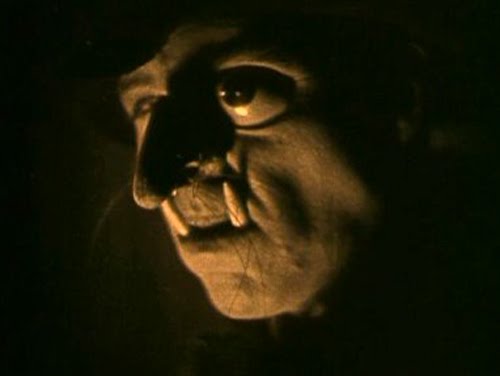
well-balanced dose of laughs and chills. With The Man Who Laughs he got to apply his skills to an epic.The story is that of a nobleman’s son who is kidnapped and disfigured by gypsies, his love for the blind girl he grew up with, and the events surrounding the reclamation of his birthright. Gwynplaine’s disfigurement has left a permanent grotesque grin on his face, and he has become famous throughout the French countryside as a carnival performer known as the Laughing Man.
 Like most epic films of the time, it’s very
melodramatic, and maybe a tad simplistic, but as a whole I’d say it belongs on
the must-see list of any die-hard film buff. There are many memorable
performances by the likes of Cesare Gravina, Brandon Hurst, Olga Vladimirovna
Baklanova, and, of course, the lovely Mary Philbin, but most of all, we have
Conrad Veidt’s amazing turn as the title character. In a time when performers
had to resort to exaggerated gestures and facial expressions in order to convey
a concept or emotion, Veidt delivers his entire performance through his eyes.
Whether with the disturbing grin, or with the lower half of his face covered,
those eyes communicate every nuance of Gwynplaine’s tortured existence.
Like most epic films of the time, it’s very
melodramatic, and maybe a tad simplistic, but as a whole I’d say it belongs on
the must-see list of any die-hard film buff. There are many memorable
performances by the likes of Cesare Gravina, Brandon Hurst, Olga Vladimirovna
Baklanova, and, of course, the lovely Mary Philbin, but most of all, we have
Conrad Veidt’s amazing turn as the title character. In a time when performers
had to resort to exaggerated gestures and facial expressions in order to convey
a concept or emotion, Veidt delivers his entire performance through his eyes.
Whether with the disturbing grin, or with the lower half of his face covered,
those eyes communicate every nuance of Gwynplaine’s tortured existence. I’m glad to have spent some time with this story, even if it is the Hollywood take on it. I’ll have to explore the book in the future, and hope I’ll get the chance to see the 2012 French adaptation.
I’ll close with one last tip of the hat to Paul Leni. Based on the two films I’ve seen, I’d say he was ahead of, and died well before, his time.
Supporting features:
Daffy Duck in Nasty Quacks (1945)
The Our Gang short Forgotten Babies (1933)
Next time:
Abbott and Costello Meet Dr. Jekyll and Mr. Hyde (1953) starring Bud Abbott, Lou Costello, Boris Karloff, and Eddie Parker