Showing posts with label silent film. Show all posts

Saturday, April 27, 2013

A Study in Classic Horror- THE MAN WHO LAUGHS (1928)


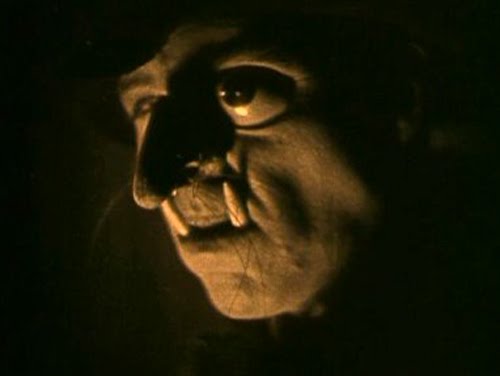
Between my enjoyment of Paul Leni’s The Cat and the Canary and my appreciation for the works of Victor Hugo, I was really looking forward to this one, and it did not disappoint. While it joins the list of films in this project that aren’t really horror, it may be my favorite of the silent works. Certainly in the horror genre it’s hard to top The Phantom of the Opera, but judged as a film of any genre, it comes darned close to being a masterpiece. With The Cat and the Canary Leni, through use of artful camera shots and creepy art direction made a wonderful atmospheric dark comedy that delivered a well-balanced dose of laughs and chills. With The Man Who Laughs he got to apply his skills to an epic.

The story is that of a nobleman’s son who is kidnapped and disfigured by gypsies, his love for the blind girl he grew up with, and the events surrounding the reclamation of his birthright. Gwynplaine’s disfigurement has left a permanent grotesque grin on his face, and he has become famous throughout the French countryside as a carnival performer known as the Laughing Man.

Like most epic films of the time, it’s very melodramatic, and maybe a tad simplistic, but as a whole I’d say it belongs on the must-see list of any die-hard film buff. There are many memorable performances by the likes of Cesare Gravina, Brandon Hurst, Olga Vladimirovna Baklanova, and, of course, the lovely Mary Philbin, but most of all, we have Conrad Veidt’s amazing turn as the title character. In a time when performers had to resort to exaggerated gestures and facial expressions in order to convey a concept or emotion, Veidt delivers his entire performance through his eyes. Whether with the disturbing grin, or with the lower half of his face covered, those eyes communicate every nuance of Gwynplaine’s tortured existence. 

I’m glad to have spent some time with this story, even if it is the Hollywood take on it. I’ll have to explore the book in the future, and hope I’ll get the chance to see the 2012 French adaptation.

I’ll close with one last tip of the hat to Paul Leni. Based on the two films I’ve seen, I’d say he was ahead of, and died well before, his time.

Supporting features:

Daffy Duck in Nasty Quacks (1945)

The Our Gang short Forgotten Babies (1933)

Next time:
Abbott and Costello Meet Dr. Jekyll and Mr. Hyde (1953) starring Bud Abbott, Lou Costello, Boris Karloff, and Eddie Parker


Sunday, January 29, 2012

A Study in Classic Horror- THE HUNCHBACK OF NOTRE DAME (1923)


This is the third film version I’ve seen of Victor Hugo’s novel Notre Dame de Paris, better known in the English speaking world as The Hunchback of Notre Dame, and it’s a large scale story to adapt dramatically in any era. Yet it’s a particularly massive undertaking for a time when films had no spoken dialogue, so it’s no wonder they called upon the talents of Lon Chaney to play the story’s best known character, Quasimodo.

Chaney was far more than a master of make-up. Even through pounds of prosthetics he knew how to convey every emotion with just a simple look. There’s a heartbreaking moment when he recognizes Esmeralda as the woman who gave him water while he was receiving a public beating, but is quickly dismayed when she recoils as he rushes to greet her. With half his face covered, Chaney manages to convey Quasimodo’s simplicity, his loneliness, his compassion, and every moment of anguish and pain.

The rest of the cast holds up their end of the story well opposite Chaney. Patsy Ruth Miller makes a good Esmeralda, particularly in the scenes when she begins to warm toward Quasimodo after he offers her sanctuary in the cathedral from the hangman’s noose. But I think Chaney’s greatest co-star is simply the enormous scope of the project. It’s just amazing to think in the early 1920s that a huge recreation of Notre Dame Cathedral was built on the back-lots of Hollywood.

It’s just a shame that this film hasn’t been preserved that well. A lot of its grandeur has been lost over time.

I do have to wonder, however, if I will ever see an accurate dramatic adaptation of Victor Hugo’s novel. I read the novel shortly after seeing Disney’s attempt at making it into musical comedic romp, and found that the original story is far darker than Hollywood would have us believe, and no version I’ve seen so far has been willing preserve Hugo’s original tone. Granted, there are versions I haven’t seen, so maybe I’ll be proven wrong.

This version, however, was still a noble endeavor, though I think the 1939 version with Charles Laughton and Maureen O’Hara is still my favorite.

This week’s supporting features:

The Looney Tunes short Eatin’ on the Cuff, or The Moth Who Came to Dinner (1942)

The Our Gang short Choo-Choo! (1932)

Next time:

Dracula’s Daughter (1936) starring Gloria Holden, Otto Kruger, Marguerite Churchill, and Edward Van Sloan


Sunday, June 26, 2011

A Study in Classic Horror- THE PHANTOM OF THE OPERA (1925)


As I prepared to watch The Phantom of the Opera, I realized I had a conundrum on my hands. The DVD set I purchased contained two different cuts of the film. One was the original 1925 version; the second was a restoration of the 1929 version which featured new footage, sound and some color, which to choose? So, I looked to the internet for advice. The majority recommended the 1929 version, but those that preferred the 1925 made a strong case for it. I tried to imagine having only seen the special editions of the Star Wars movies without having ever seen the originals, and I just couldn’t, so I decided the best approach was to watch both versions, and I’m glad I did.


For future viewings, I wish I could somehow combine what I liked best about the two. There’s no arguing that with the restoration, the later cut certainly looks better, yet some of the revisions are rather awkward. I could have done without the dubbed over dialogue. I don’t know how much of the original cast was brought in to add vocals, but it doesn’t matter when they can’t possibly sync up with the mouth movements (if any) onscreen. Worst of all, as Lon Chaney was contracted to a different studio when the revisions were made, a different actor is heard when the Phantom speaks, and I don’t particularly care to see Chaney’s performance tarnished by someone else’s. On the plus side for the later version, the rearrangement of some scenes makes them work better dramatically, for example: the murder of a stagehand occurs much later in the ’29 than in the ’25, and as this death is the catalyst for the mob in the film’s climax, the flow of murder to mob is more organic than the broken up series of events in the ’25. Best of all visually, is the early Technicolor sequence, particularly the scene where the young lovers plot their flight from Paris on the roof of the Opera House unaware of the disguised Phantom watching from above as his bright red cloak flaps in the breeze against the night sky.


There is a third way you can watch the film in this set. There’s an alternate orchestral score, written more recently, to accompany the ’29 version. This replaces the entire soundtrack and therefore eliminates the clunky dialogue, but it also eliminates the operatic performances that were added. Ideally, I would want to keep the singing, but lose the dialogue, but that’s not possible. I guess there’s no perfect way of watching the film, so I guess in the future I will settle for the ’29 cut with the newer score.


But those are just my thoughts on the edition of the film, on to the film itself. Phantom is one of those films I wish I could experience the way the original audiences did. The scale of the film itself is a remarkable for the time it was made in with its enormous sets and hundreds of extras, but most of all I wish I could feel the thrill the early audiences felt when Mary Philbin unmasks the Phantom to reveal Lon Chaney’s grotesque make-up. When promoting the film, Universal kept Chaney’s make-up a secret, (see the trailer in my previous entry) so when that mask came off people were seeing it for the first time. I remember seeing that clip when I was very young and finding it frightening, but by then photos of the Phantom were in wide circulation. I’m sure little compares with the impact the unmasking had on those first audiences.


A great performance by Chaney is adequately supported by Mary Philbin and Norman Kerry as Christine and Raoul. Arthur Edmund Carewe as the mysterious secret policeman Ledoux is another notable performance. There’s a bit of gasping for breath as Kerry and Carewe find themselves ensnared in some of the Phantom’s death traps.


Oh, and since I’ve often discussed clichés: according to Michael Mallory’s Universal Studios Monsters: A Legacy of Horror, this film marks the first use of the angry mob, which would become a horror movie staple.

This week’s supporting features:

Bugs Bunny in Herr Meets Hare (1945)

The Our Gang short The First Seven Years (1930)

Next week’s film:

Frankenstein (1931) starring Boris Karloff, Colin Clive, Dwight Frye and Mae Clarke

Sunday, May 15, 2011

A Study in Classic Horror – THE CAT AND THE CANARY (1927)


Once again, we return to early versions of clichés we’ve know for ages. Based on a popular stage play of the era, The Cat and the Canary is a comedic haunted house thriller based around the now-familiar motif: the reading of the rich relative’s will to his horde of greedy relatives. Other familiar elements include: secret passages, an escaped lunatic, a cut telephone line, a creepy claw that reaches out of walls, a body that tumbles out of a closet and one more cliché that I’ll discuss later. The only thing missing: the painting of the late Cyrus West is lacking a pair of eyeholes that allow an unseen spy to watch the proceeding of the room. Still, there are other haunted house movies to come, perhaps we’ll get to that one later. Clichés they may be, but as I stated in my entry on The Raven, there’s a lot of fun to be had in seeing them in some of their earliest realizations.

As is usually the case when you inherit a fortune from someone who owns a spooky house, you must spend the night in said house. In this instance, however, that is not a stipulation of the will, this time Annabelle, the chosen recipient of the fortune, and the other relatives must stay the night because of the danger of the aforementioned escaped lunatic. As the reluctant inhabitants of the house begin to disappear and strange occurrences seem to center only around Annabelle when she’s alone, her sanity begins to come into question, and by the conditions of the will, she must be certified sane by a physician or the money will pass to another specified heir

I’M GOING TO DISCUSS A REVEALING PLOT POINT HERE, SO YOU MAY WANT TO SKIP THIS PARAGRAPH IF YOU HAVEN’T SEEN THE FILM. As you may have guessed, every thing is eventually explained as the machinations of the heir who the fortune will fall to if Annabelle is declared insane, and that’s the final cliché I want to discuss: what I’ve come to call the Scooby-Doo villain. Anyone who’s watched cartoons since the late sixties is familiar with the idea of the miscreant who dresses up as a monster as a means to achieve his goal, usually preying on local superstitions or, as in this case, trying to drive someone mad. It’s amusing to see this idea dates back long before such villains could be foiled by a gang of teenagers and their dog. There’s even a very Scooby-esque unmasking of the culprit. I wonder if there have been many real-life criminals who have used this technique.

The film has a great cast that includes the lovely Laura LaPlante and Gertrude Astor, Creighton Hale as the nebbish hero, Flora Finch as a doddering aunt who bears an uncanny resemblance to Jean Stapleton, and Martha Mattox as a creepy maid called Mammy Pleasant who could give lessons to Rebecca’s Mrs. Danvers. But the real star is the director: Paul Leni. This was my introduction to Leni, a German expressionist who made his American debut with this film. Though it’s often very funny, Leni never lets go of the thriller aspects of the film with its dark moving shadows, slow tracking shots down darkly lit halls and long curtains that blow eerily in the wind. He also makes some dramatic use of superimposed shots. The film opens with a shot of the huge and imposing mansion with a distraught Cyrus West superimposed over it. As we are told of his greedy relatives waiting for him to die, the mansion is replaced by empty medicine bottles and menacing cats pawing at poor Cyrus. Later a scary skull looms over a character’s head when he blanches at the word “death”. Leni even extends his touch to the dialogue cards as the words become large and animated when a character is frightened. This also may be the earliest example I’ve seen of stylized credits: the first visual in the film is that of a gloved hand reaching past cobwebs to wipe away a thick layer of dust to reveal the film’s title.

It makes me look forward to Leni’s other film on my list, The Man Who Laughs. It’s sad that he died in 1929 at the age of 44. I would love to have seen what he might have done with sound and color.

This week’s supporting features:

Bugs Bunny and Witch Hazel in Bewitched Bunny (1954)

The Our Gang short Boxing Gloves (1929), the first short in the series to feature Jackie Cooper, who passed away earlier this month.

I’m not sure when I’ll get to the next film. Probably May 27th at the latest, so I’ll leave the schedule open for the next couple of weeks. The film in question will be:

The Mummy (1932) starring Boris Karloff and Zita Johann